
Bridging Discovery and Diagnostics:
How Automation Transforms Laboratory Workflows
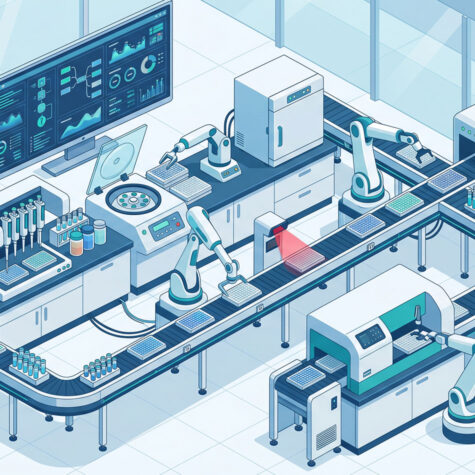
Moving a process from R&D into diagnostics is often treated as a question of scale. In practice, it’s something else entirely. A discovery workflow rarely translates directly into a diagnostic environment without significant re-engineering. This isn’t a flaw in science—it reflects two fundamentally different operating realities.
In discovery, variability is tolerated if trends are clear. Skilled users adjust timing, compensate for inconsistencies, and interpret outcomes in real time. In diagnostics, flexibility disappears. Every step must be reproducible, every outcome defensible, and every variable defined, documented, and controlled. Variability that is tolerable in discovery becomes unacceptable in diagnostics.
This gap shows up in subtle but important ways. A centrifugation step that “works” in research may produce slightly different pellet formation depending on acceleration or braking behavior. A delay between steps that is inconsequential in manual workflows can affect downstream performance in automated workflows. These are not noticeable dramatic failures; they are small inconsistencies that accumulate.
Automation doesn’t eliminate these issues—it exposes them. And when that happens, teams often find themselves revisiting both the process and the equipment later than expected. In the next post, we’ll look more closely at why automation amplifies these challenges instead of solving them.
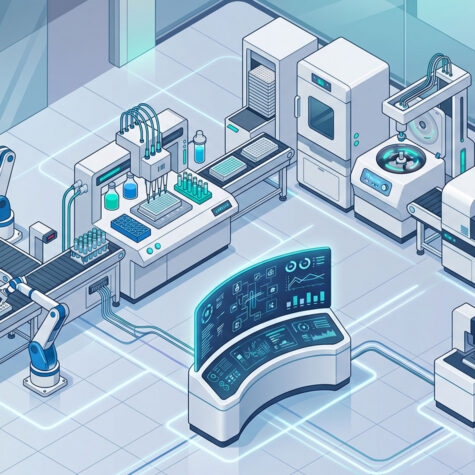
Automation is often seen as the natural next step after a successful research workflow. If a process works manually, the assumption is that automation will simply make it faster and more efficient. In reality, automation changes the nature of the process itself.
Manual workflows are inherently forgiving. Small variations in timing, handling, or equipment behavior are absorbed by the operator. In an automated system, those same variations become fixed. Timing is exact, sequences are rigid, and there is no opportunity for correction mid-process.
This is where equipment begins to matter in a different way. In research, instruments support the process. In automation, they define it. A centrifuge’s acceleration profile, imbalance tolerance, or temperature behavior is no longer incidental—it directly shapes the workflow’s outcome. Even minor inconsistencies can propagate across hundreds or thousands of cycles.
Automation scales execution—but it also scales any underlying inconsistency. This is why many automated workflows that appear stable in development encounter issues during validation. In the next post, we’ll focus on one step—centrifugation—and how stabilizing it can reduce this risk.
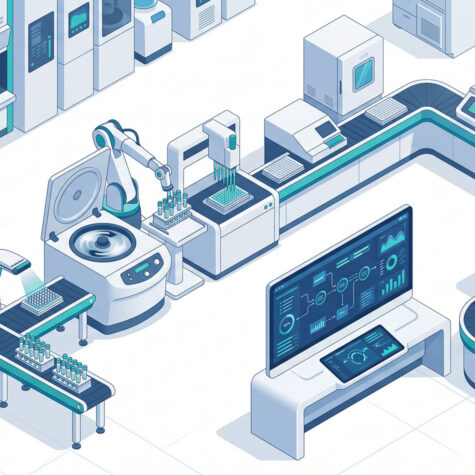
What if centrifugation didn’t need to be reworked for automation? Centrifugation is one of the most common points of variability in automated workflows. It sits at a critical junction—affecting separation quality, downstream liquid handling, and overall process timing. In manual environments, these variables are often managed implicitly. In automation, they must be controlled precisely.
The Hettich Line of automated centrifuges approaches this in a different way. Rather than adapting a research centrifuge for automation, it was designed from the outset to operate as part of an integrated system. Robotic loading, consistent motion control, and defined operating behavior allow it to function as a predictable, repeatable step within a larger workflow.
This includes stable control over acceleration and braking, tolerance to real-world imbalances, and compatibility with a wide range of labware used across both research and diagnostic settings. Combined with long-term operational stability, it provides a level of consistency that reduces the need to revisit centrifugation during process transfer.
It doesn’t eliminate the broader challenges of moving from discovery to diagnostics—but it removes one of the most common sources of rework. The remaining question is not just about consistency—it’s about whether that consistency can be proven, documented, and trusted in a regulated environment. In our final post, we’ll explore why that distinction matters.
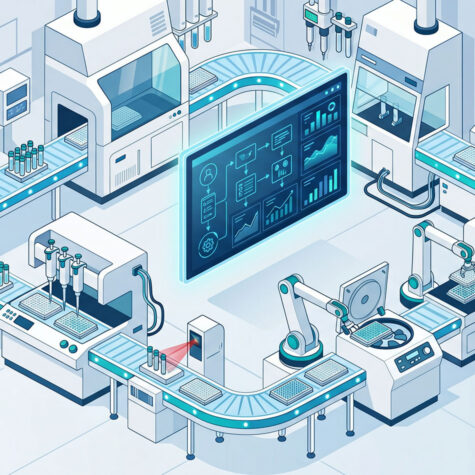
Achieving consistent performance is only part of the challenge in diagnostics. The next requirement is equally important: that performance must be demonstrable, documented, and auditable. In other words, it’s not enough for a system to work—it must be proven to work under defined conditions, every time.
This is where IVD and MDD certification frameworks come into play. They require that the equipment operates within validated limits, that performance is traceable over time, and that any changes are controlled and documented. These requirements turn consistency into something that can be truly verified.
For automation, this distinction is critical. A system built on uncertified components may appear stable, but without documented performance and traceability, it cannot be fully validated. This often leads to late-stage challenges, where workflows must be re-evaluated—not because they fail, but because they cannot be formally proven to succeed.
Hettich’s approach reflects decades of attention to this transition. Designing systems like the ROTANTA 460 Robotic with both automation and diagnostic requirements in mind—including IVD-aligned design principles—they help ensure that processes developed in research can move forward with fewer barriers. The result is not just a more stable workflow, but one that is ready for the demands of regulated use from the outset.
Automation and robotics inspire these discussions, and we are always open to continuing the conversation with you personally.